


Quick Answer: There are five main types of chainsaw blade sharpener and the right one depends on where you sharpen, not on price. A bar-mount unit like the Granberg G1012XT sharpens on the saw in the field, a file guide covers one homeowner chain, a handheld rotary tool cuts fast but freehand, a bench grinder handles volume, and a bandsaw sharpener is the only one that touches a mill blade.
Pick the wrong type, and you end up owning a tool that technically sharpens but never gets used, because it lives in the wrong place. This guide covers what each type does, where each one fails, the angle specifications that decide whether a sharpened chain actually bites, and how to match a setup to the way you work.
Key Takeaways:
-
Bar-mount sharpeners keep the chain on the saw. No breaking the chain, no removing it from the bar, no losing the tension you had dialed in.
-
Clamp-on file guides are the cheapest correct method. They hold the file at a fixed angle, which is the only thing separating a sharpened chain from a ruined one.
-
Bench grinders win on volume. Running eight chains through a fixed station is a job. Running eight through a field unit is an afternoon.
-
Bandsaw blades need their own machine. Chain cutters and band blade teeth are different geometry, so a chain sharpener will not touch a band blade unless it is a combination unit built for both.
-
Top plate angle is typically 25 to 35 degrees. Most chains sit near 30 degrees, and the figure is printed on the chain pack.
-
Depth gauge setting is 0.025 inches as a baseline. Ignore the gauges and perfectly sharpened cutters still will not reach the wood.
- One machine can cover both jobs. The Hud-Son 2-in-1 sharpens saw chain and band blades on the same unit, which matters if you run a mill and a saw.
Which Type of Chainsaw Blade Sharpener Do You Need?
Match the sharpener to where you work, not to a price point.
|
Your Situation |
Best Type |
Why |
|
Sharpening in the field, away from mains power |
Bar-mount 12V |
Runs off a truck battery, chain stays on the saw |
|
Chainsaw milling, chain dulls mid-session |
Bar-mount 12V |
Resume in five minutes instead of packing up |
|
Occasional firewood, one or two chains |
Clamp-on file guide |
No power needed, correct angle held |
|
Touching up a few teeth, rotary tool already owned |
Handheld rotary |
No new tool needed, but use the guide attachment |
|
Multiple chains per day, fixed shop |
Bench or tabletop electric |
Fastest per chain once the chain is off |
|
Running a bandsaw mill |
Bandsaw blade sharpener |
Chain sharpeners cannot touch band blades |
|
Running both a chainsaw and a bandsaw mill |
2-in-1 combination unit |
One bench, both jobs |
|
Off-grid or generator power only |
Low-wattage bench, or 12V bar-mount |
Draw stays inside inverter capacity |
The split that matters most is field versus bench. A sharpener that lives on a workbench will not help you when a chain dulls two miles into a woodlot, and a 12V unit will not out-produce a fixed grinder when you have a rack of chains waiting.

Pro-Tip: Check pitch compatibility before anything else. A sharpener that stops at 3/8 pitch cannot touch a .404 mill chain, and no amount of build quality makes up for a machine that physically will not fit your chain.
What Is a Chainsaw Blade Sharpener?
A chainsaw blade sharpener is any tool that restores the cutter geometry and depth gauge height of a saw chain to their original specifications. The important word is geometry. Every cutter has a top plate angle, a side plate angle, and a depth gauge height, and a sharpener's only real job is reproducing those three values identically across every cutter on the loop.
That is why type matters more than brand. A basic guide that holds the angle produces a better chain than an expensive tool used freehand.
The Five Main Types at a Glance
|
Type |
Power |
Where It Works |
Main Limitation |
|
Bar-mount (powered) |
12V |
Field, truck, mill site |
Slower per cutter than a bench unit |
|
Clamp-on file guide |
None |
Anywhere |
Operator fatigue drifts the angle |
|
Handheld rotary |
Cordless or corded |
Anywhere, if you own the tool |
Removes metal fast, easy to overgrind |
|
Bench or tabletop |
120V |
Shop, garage |
Chain must come off the saw |
|
Bandsaw sharpener |
120V |
Shop, mill shed |
Band blades only, unless it is a 2-in-1 |
What Every Type Has to Get Right
All five have to hold a fixed angle and let you lower depth gauges. A sharpener that grinds cutters but makes no provision for the gauges leaves you with a chain that looks sharp and refuses to pull into the cut, because the gauges are physically holding the cutters off the wood.
Bar-Mount Chainsaw Sharpeners
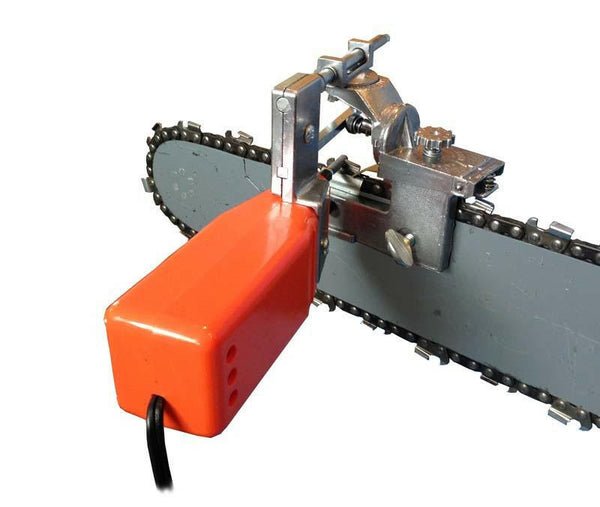
A powered bar-mount sharpener clamps to the chainsaw bar and sharpens each cutter while the chain stays on the saw. You pull the chain through the bar groove by hand, sharpen the tooth in front of you, advance one link, repeat.
Nothing gets disassembled. There is no breaking the chain, no carrying spares, and no resetting tension afterward. For anyone running a chainsaw mill, this is the difference between a five-minute pause and losing the rest of the day, because ripping along the grain dulls a chain far faster than crosscutting does.
The Granberg Alaskan mill range ships with the same 12V grinder for exactly that reason. The trade-off is speed per cutter: a bar-mount unit is slower tooth for tooth than a bench grinder, so it is the wrong tool for working through a rack of chains in a shop.
Granberg G1012XT Specifications
|
Specification |
Detail |
|
Power |
12V from a truck battery, jump starter, or power station |
|
Motor speed |
24,000 rpm |
|
Mount time |
About 60 seconds to the bar |
|
Chain types |
Crosscut, ripping and skip tooth |
|
Saw compatibility |
Stihl, Husqvarna, Echo and other major brands |
|
Adjustments |
Angle, file height, tooth length |
|
Depth gauges |
Lowers gauges on the same unit |
|
Build |
Cast aluminum, molded polycarbonate, zinc-plated steel |
The Granberg G1012XT is the bar-mount unit we carry. The bar-mounted design locks the grinding angle, so every tooth comes off the stone identically rather than depending on a steady hand. Granberg International has manufactured chainsaw accessories since 1948, and the body is made of cast aluminum, molded polycarbonate, and zinc-plated steel.

Pro-Tip: Keep a 12V jump starter in the truck alongside the sharpener. It powers the unit without running the engine, which matters on a mill site where you are parked for hours and do not want to drain the battery you need to get home on.
Clamp-On File Guides
A clamp-on file guide holds a round file at a fixed angle against the cutter so every tooth receives the same geometry. Some clamp to the bar itself and some to the cutter. It is the cheapest approach that still produces a correctly sharpened chain, and it needs no power at all.
Why Freehand Filing Ruins Chains
Freehand filing is where most chains get destroyed. A file held two or three degrees off on each stroke produces cutters of unequal length and angle, and a chain like that pulls to one side and cuts a curve rather than a straight kerf. The saw then needs downward pressure to cut at all, which is the point most people wrongly conclude the chain is worn out.
When a File Guide Is Enough
For a property owner cutting two or three cords a season on one or two chains, a file guide is genuinely sufficient. Past that volume, the time cost overtakes the tool cost saved, usually around the point you are sharpening more than once a week.
Handheld Rotary Sharpeners
A handheld rotary sharpener is a rotary tool fitted with a small grinding stone sized to your chain's pitch, used either freehand or with a clip-on guide attachment. It sits between a file guide and a bench grinder, faster than filing but less repeatable than a fixed station.
The appeal is that most people who want one already own the rotary tool. Adding a set of chain stones and a guide turns a tool you have into a sharpener for the price of the accessories, and cordless versions work away from mains power.
The tradeoff is control. A powered stone removes metal far quicker than a file, so freehand, it is easy to overheat a cutter or take more off one tooth than the next, which produces exactly the uneven chain a guide exists to prevent. Treat the guide attachment as required equipment, and check the stone diameter against your chain pitch the same way you would check a file size.
LogOX does not stock a rotary sharpener. If you want field sharpening with geometry that repeats from tooth to tooth, the Granberg G1012XT mentioned above holds the angle mechanically rather than relying on a steady hand.
Bench and Tabletop Electric Sharpeners
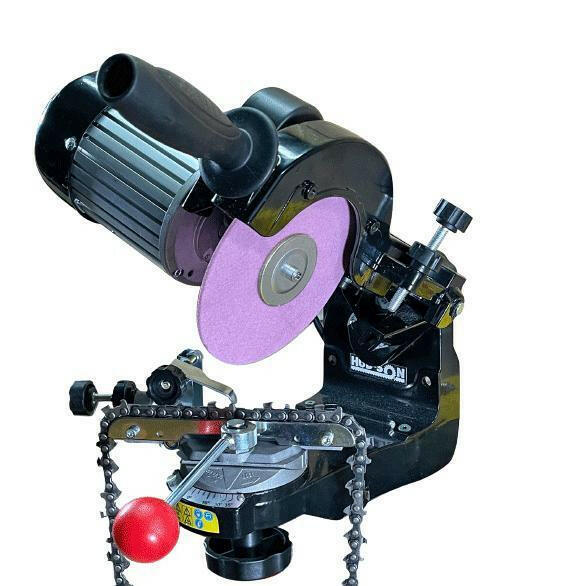
A bench chainsaw blade sharpener is a fixed electric grinder that works on a chain removed from the saw, and it is the fastest option per chain once the chain is off. You set the angle once, index each cutter against a stop, and grind.
What to Check Before Buying
|
Check |
Why It Matters |
|
Pitch range |
A unit stopping at 3/8 will not sharpen .404 mill chain |
|
Power draw |
Decides whether it runs off an inverter or generator |
|
Mounting |
Bench or tabletop changes where it can live |
|
Stone dressing |
A dressable stone covers more blade profiles |
The Hud-Son 2-in-1
The Hud-Son 2-in-1 Band Blade and Chainsaw Sharpener covers 1/4, .325, 3/8 and .404 pitch chains, which spans consumer chain through to mill chain. It runs a 120V household motor drawing only 230 watts, low enough for an inverter or a small generator, which makes it workable in a remote mill shed. It bolts to a workbench or tabletop and is made in the USA.
Pro-Tip: Number your chains with a paint pen and rotate them. Running three chains in sequence and sharpening all three in one bench session is far faster than sharpening one chain three separate times.
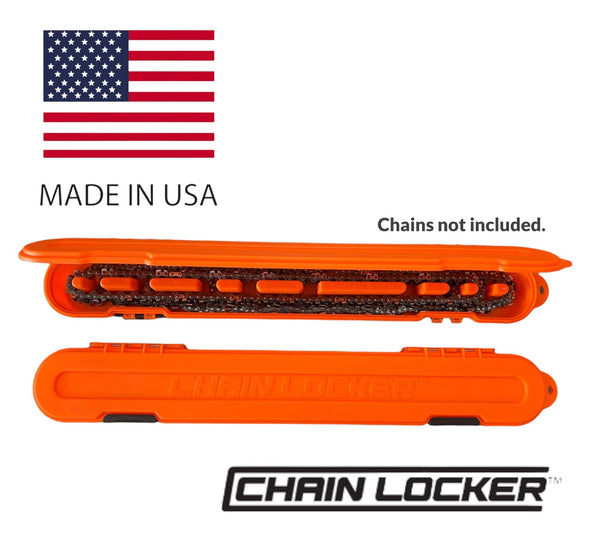
A rotation only works if the chains stay sorted, which is what a chain storage case is for. Keeping sharp and dull chains separated saves you re-sharpening a chain you already did.
Bandsaw and Sawmill Blade Sharpeners
A bandsaw blade sharpener grinds the teeth of a continuous band blade, and a chain-only sharpener cannot do this job. The geometry is not sufficiently similar to adapt, which is why a machine that does both carries out a separate function for each job.
Chain Cutter Versus Band Blade Geometry
|
Feature |
Saw Chain Cutter |
Bandsaw Blade Tooth |
|
Form |
Individual cutters riveted to drive links |
Repeating teeth cut into one continuous band |
|
Key surfaces |
Top plate, side plate, depth gauge |
Tooth face, gullet, set |
|
Wear point |
Cutting corner rounds over |
Tooth tip dulls, gullet fills |
|
Sharpening motion |
One cutter at a time, indexed |
Continuous feed around the blade |
If you run a portable sawmill, sharpening in-house changes the mill's economics outright. Blades dull on every knot, on bark grit, and on the occasional embedded nail, and a mill running dull blades produces wavy cuts while burning more horsepower for the same board feet.
The Premium Bandsaw Blade Grinding Stone
The Premium Bandsaw Blade Grinding Stone is the dedicated stone for sawmill blades on the Hud-Son unit. It performs full-blade-contour sharpening, requires no stone dressing, and sharpens the blade gullet, which improves how the re-sharpened blade performs. It is profiled for Hud-Son 10-degree blades and is sold separately from the sharpener.

If you are still choosing between mill types, our portable sawmill comparison covers where a chainsaw mill sits against a band sawmill, which determines which sharpening problem you inherit.
Sharpening Angles That Decide Whether a Chain Cuts
Sharpening geometry is a specification, not a preference, and two numbers do most of the work: top plate angle and depth gauge height. Both are printed on the chain packaging or listed in the saw manual.
Top Plate Angle
|
Angle |
Effect on Cutting |
|
25 degrees |
Slower cut, edge holds longer, suits hard or dirty wood |
|
30 degrees |
Standard on most chains, balanced speed and durability |
|
35 degrees |
Faster bite, edge dulls sooner, suits clean softwood |
Depth Gauge Settings by Wood Type
|
Wood |
Depth Gauge Setting |
|
Softwood |
0.030 inches for a bigger bite in low-resistance wood |
|
General purpose |
0.025 inches as the standard baseline |
|
Hardwood |
0.020 inches to stop the chain grabbing in dense wood |
Your chain packaging and saw manual carry the correct figures for the specific chain you run, and 0.025 inches is the usual starting point across standard chains. Check the pack before assuming the default.
This is the step most people skip. Cutters shorten every time they are sharpened, but depth gauges do not shorten with them, so after several sharpenings the gauges stand proud and hold the cutters off the wood. Any sharpener worth buying handles both operations, and the Granberg G1012XT lowers gauges on the same unit that grinds the cutters.
Pro-Tip: Sharpen every cutter back to the length of the shortest one. Chasing a single damaged cutter to full length while leaving the rest long produces the same uneven cut as filing at the wrong angle.
How Often Should You Sharpen?
Sharpen when the saw starts producing dust instead of chips, not on a fixed schedule. A sharp chain throws square-edged chips and pulls itself into the cut. A dull chain produces fine powder and has to be pushed, which is the clearest signal there is.
What Dulls a Chain Fastest
|
Cause |
Effect |
|
Dirt or grit in bark |
Takes the edge off in a single contact |
|
Milling along the grain |
Far more cutting distance and heat per pass |
|
Frozen or dried hardwood |
Harder on steel than green softwood |
|
Touching soil at the end of a cut |
Immediate, and usually the worst of the four |
Sharpening Frequency by Task
|
Task |
Practical Interval |
|
Firewood crosscutting, clean wood |
One touch-up per tank of fuel |
|
Storm cleanup or dirty bark |
Check after every tank, expect more often |
|
Chainsaw milling |
Between slabs on long sessions |
|
Bandsaw milling |
When cuts start wandering or waving |
Chainsaw millers sharpen more often than anyone, because a dull chain in a mill wanders and leaves a wavy slab surface that costs more time in planing than the sharpening would have taken. That is why the Granberg Backcountry bundles include a grinder alongside the mill.
Frequently Asked Questions
1. What is the best type of chainsaw blade sharpener?
For field use, a bar-mount 12V sharpener, because it works without removing the chain. For shop volume, a bench grinder. For a single homeowner chain, a clamp-on file guide is enough.
2. Do chainsaw sharpeners actually work?
Yes, provided the sharpener holds a fixed angle. The failure mode is freehand filing, not powered sharpening, because an inconsistent angle across cutters makes a chain cut crooked.
3. Is it better to sharpen a chainsaw chain or buy a new one?
Sharpen it. A chain can be sharpened many times before the cutters reach the wear mark, and a bar-mount unit like the Granberg G1012XT costs roughly what a handful of replacement chains does. Bench and combination units cost more, so they earn their keep once you are sharpening regularly.
4. Can a chainsaw sharpener sharpen a bandsaw blade?
No, unless it is built for both jobs. Chain cutters and band blade teeth have different geometry, which is why combination units like the Hud-Son 2-in-1 carry a separate function for each.
5. What angle do I sharpen my chainsaw chain at?
Typically 25 to 35 degrees on the top plate, with most chains around 30 degrees. The exact figure is printed on your chain packaging or in the saw manual.
6. What pitch chains can the Hud-Son 2-in-1 sharpen?
It handles 1/4, .325, 3/8, and .404 pitch saw chains, covering standard consumer chains through to mill chain.
7. Can I sharpen a chain without removing it from the saw?
Yes. A bar-mount sharpener clamps to the bar and sharpens each cutter in place while the chain stays on the saw.
8. Will a sharpener run off a generator or inverter?
The Hud-Son 2-in-1 draws 230 watts on a 120V motor, low enough for an inverter or small generator. The Granberg G1012XT runs on 12V from a truck battery or portable power station.
9. How do I know when a chain is worn out rather than dull?
Every cutter carries a wear mark showing its minimum length. Once the cutters have been filed back to that line, the chain is finished, and sharpening will not bring it back.
The Right Sharpening Setup for Your Saw
For cutting and occasional milling where sharpening has to happen at the wood, the Granberg G1012XT is the right unit, because it runs off a truck battery and never requires taking the chain off the saw. For a shop or mill shed running both saws and band blades, the Hud-Son 2-in-1 covers both jobs from one bench.
The sharpening setup, matched to how you work:
-
Granberg G1012XT: Bar-mounted 12V, sharpens on the bar, runs off a truck battery. For field and mill-site work.
-
Hud-Son 2-in-1 Band Blade and Chainsaw Sharpener: Bench unit covering 1/4 to .404 pitch chain plus band blades. Draws 230 watts, so it runs off an inverter.
- Premium Bandsaw Blade Grinding Stone: Full contour sharpening for Hud-Son 10 degree mill blades. Requires the 2-in-1.
Both units sit in the electric chain and blade sharpeners collection. If you are building out a wider kit, our overview of logging hand tools covers the handling and felling tools that sit around the saw work, and our forestry tools guide for beginners covers what to prioritize first on a new property.




Leave a Comment
We read every one. Share your setup, ask a question, or drop a tip for fellow wood burners.