


Whether you're cutting firewood, managing timber, or working in professional forestry, having the right equipment is essential for safety and efficiency. Understanding the types of logging tools used in the field can help you choose the best equipment for felling, bucking, lifting, moving, and processing logs. From traditional hand tools to modern forestry aids, this guide provides a complete overview of the most important logging tools and their practical applications.
Key takeaway
● Logging tools are specialized hand tools designed to make felling, bucking, moving, and processing timber safer and more efficient in the field.
● Essential forestry equipment includes axes, wedges, cant hooks, peaveys, logging tongs, and handsaws, each serving a specific purpose during logging operations.
● Choosing the right logging tool depends on factors such as log size, terrain, task requirements, and the user's experience level.
● Proper maintenance, including sharpening, cleaning, and regular inspections, extends tool lifespan and improves performance and safety.
● Investing in the correct combination of logging tools and personal protective equipment (PPE) helps reduce fatigue, increase productivity, and minimize the risk of injury.
Quick Answer: The Main Types of Logging Hand Tools
The primary types of logging hand tools are cutting tools, splitting tools, log handling tools, marking and measuring tools, and limbing or clearing tools. Together, this handful of well-chosen field tools covers every essential stage of timber work, including felling, bucking, moving, splitting, and measuring logs efficiently.
The 5 Core Categories of Logging Hand Tools
Every stage of traditional forestry and log management relies on a specific set of manual tools designed for leverage, precision, and safety.
● Cutting Tools (Felling & Bucking): These tools are used to bring trees down and cut them into manageable lengths.
Examples: Felling axes, crosscut saws, and pocket chainsaws.
● Splitting Tools (Processing): Designed to force wood fibers apart along the grain, typically for firewood production.
Examples: Splitting mauls, wedges, and froes.
● Log Handling Tools (Moving): Engineered to provide leverage, protecting your back while rolling, lifting, or dragging heavy timber.
Examples: Cant hooks, peaveys, log tongs, and timber carriers.
● Marking & Measuring Tools (Scaling): Used to calculate board feet, mark cut points, and ensure uniform log lengths before bucking.
Examples: Loggers' tapes, scale sticks, and marking chalk/paint.
● Limbing & Clearing Tools (Site Prep): Used to strip branches from a felled tree and clear underbrush around the work area.
Examples: Billhooks, machetes, and limbing axes.
Summary of Tools by Work Stage
|
Work Stage |
Primary Tool Category |
Common Hand Tool |
|
Felling (Dropping the tree) |
Cutting Tools |
Felling Axe / Crosscut Saw |
|
Limbing (Removing branches) |
Limbing/Clearing Tools |
Limbing Axe / Billhook |
|
Measuring (Sizing up cuts) |
Marking/Measuring Tools |
Logger's Tape / Scale Stick |
|
Bucking (Cutting into logs) |
Cutting Tools |
Bucking Saw / Wedges |
|
Moving (Transporting timber) |
Log Handling Tools |
Peavey / Cant Hook / Tongs |
|
Splitting (Processing firewood) |
Splitting Tools |
Splitting Maul / Wedges |
The 5 Categories of Logging Hand Tools
Understanding the main types of logging tools is essential for choosing the right forestry hand tools for managing timber efficiently and safely. These different types of forestry equipment are categorized by their specific role in the woods, running from the initial drop of a tree to the final processing of the wood.
Cutting Tools - Axes, Hatchets, and Hand Saws
Cutting tools are the foundation of manual forestry, designed to slice through wood fibers for felling, bucking, and cleaning up timber.
● Felling Axe: A heavy, long-handled tool designed primarily to fell and limb trees by hand using deep, powerful swings.
● Hatchet: A compact, short-handled axe ideal for clearing small branches, splitting kindling, and managing quick trail work.
● Bow Saw: A tensioned, C-shaped hand saw built for making fast, efficient cuts on small- to medium-sized logs.
● Crosscut Saw: A large, two-handed or one-handed saw designed to fell and buck larger logs without power by utilizing specialized teeth to clear sawdust.
● Pruning/Folding Saw: A compact, razor-sharp saw that folds away safely, used for making precise, clean cuts on smaller branches and limbs.
● Felling Wedges: Angled plastic or metal inserts driven into a saw cut to control the tree's fall direction and prevent the saw blade from binding under the log's weight.
Splitting Tools - Mauls, Wedges, and Sledges
Once timber is bucked into manageable rounds, splitting tools are used to rend the wood apart along its natural grain. Rather than cutting the wood fibers, these heavy-duty forestry hand tools rely on blunt force and wedge angles to pop the logs open.
● Splitting Maul (6 to 8 lb): A heavy, wedge-shaped tool featuring a blunt driving head on one side and an axe edge on the other, designed specifically to split large wood rounds along the grain.
● Steel Wedge: A heavy metal wedge driven directly into stubborn or oversized wood rounds with a sledgehammer to force them apart when a standard maul isn't enough.
● Sledgehammer: A heavy, long-handled hammer used exclusively to drive steel splitting wedges into large, dense logs.
Technique Tip: To prevent fatigue and maximize safety, always let the tool's mass do the work; lift the maul or sledge smoothly and let gravity and momentum drive the heavy head through the wood.
Log Handling and Moving Tools - Cant Hooks, Peaveys, Pickaroons, Carriers
Log handling tools are designed to provide maximum leverage and grip when manipulating heavy, awkward timber. Utilizing the correct tool allows you to roll, drag, and lift wood safely while maintaining total control.
● Cant Hook: Features a heavy-duty handle paired with a swinging, movable steel hook and a blunt, toothed end to solidly grip, roll, and reposition logs without twisting your spine.
● Peavey: Similar to a cant hook, but terminates in a long, pointed metal spike rather than a blunt toe, providing an aggressive point for prying frozen logs or pushing timber apart.
● Cant Hook vs. Peavey: While a peavey utilizes a pointed spike for prying and separating logs, a cant hook uses its blunt, toothed tip exclusively for rolling. Because of these focused mechanics, many private landowners prefer a cant hook for general rolling and sawmill work.
● Pickaroon (Hookaroon): A lightweight tool featuring a backward-curved, pointed steel pick on a long handle that allows you to grab, drag, and stack firewood rounds seamlessly without constantly bending over.
● Log Tongs: A scissor-action tool used to securely bite into and lift shorter log sections or firewood pieces using either a one-handed or two-handed design.
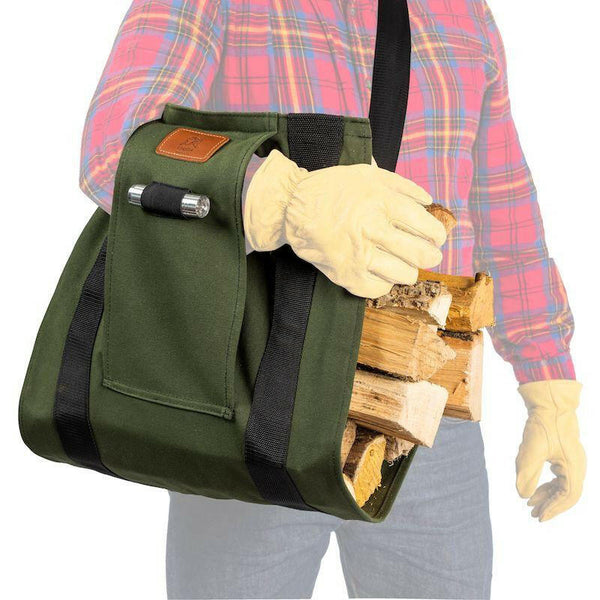
● Log Carrier: A two-person or specialized one-person canvas-and-frame system that lets you comfortably transport split wood or small logs while protecting your back from awkward weight distribution.
● Log Arch / Timberjack: A mechanical lift that raises one end of a log completely off the ground, keeping it stable and preventing your chainsaw chain from striking the dirt during bucking cuts.

Upgrade Your Woodlot Setup with LogOX
If you want to replace bulky, single-purpose forestry equipment with a more efficient workspace, the innovative, American-made LogOX system streamlines your entire log-handling workflow:
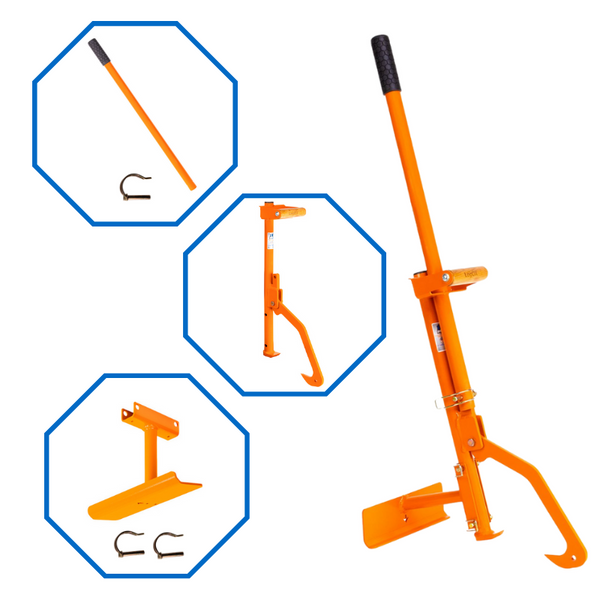
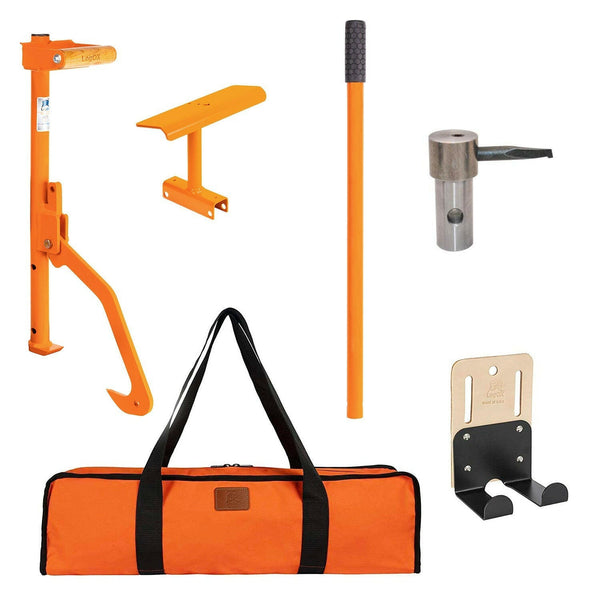
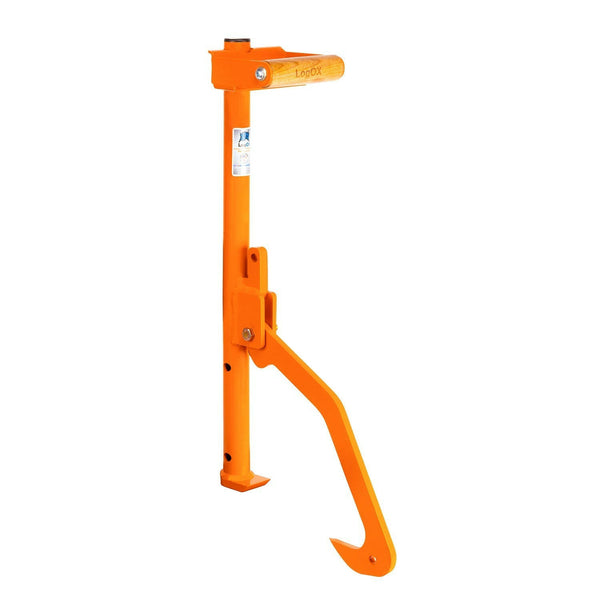
● LogOX 3-in-1 Forestry MultiTool: A patented, modular system that combines three essential log-handling tools into one versatile design. It seamlessly transforms into an ergonomic log hauler, a 40-inch cant hook, or a stable timberjack to elevate logs for faster, safer bucking.
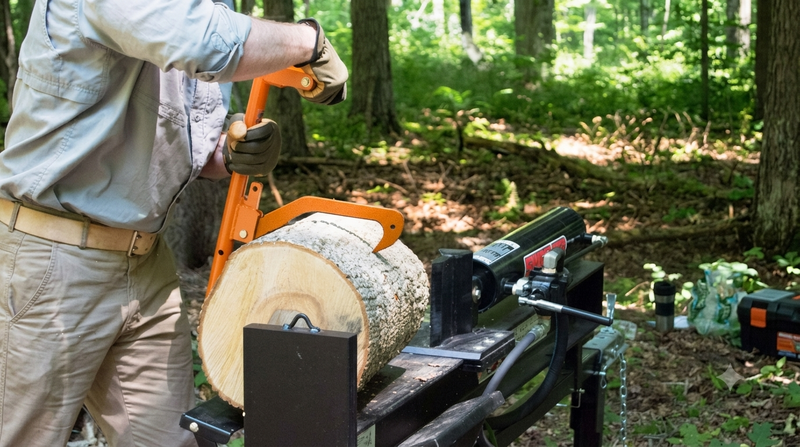
● LogOX Hauler: An ergonomic lifting-and-carrying hand tool that acts as an extension of your arm, letting one person lift, drag, and load log rounds into a splitter with significantly less back and quadriceps strain, 93% and 89%, respectively.
● PickOX Pickaroon Attachment: A rigid pickaroon attachment that locks directly into your existing LogOX handle frame, instantly providing an aggressive, replaceable-tip hook for dragging and sorting wood without bending over.
● LogOX Cant Handle Extension: When you require heavy-duty leverage for massive logs, this rigid steel extension easily connects to your base tool via a hitch pin to form a full-length, high-leverage cant hook.

Marking and Measuring Tools
Accurate scaling ensures you get the most out of every tree, reducing waste and maximizing yield before making a single cut. Specialized log marking tools and scaling gear allow you to calculate board feet, grade timber, and trace dimensions efficiently.
● Lumber Crayon / Marking Paint: Weather-resistant, highly visible markers used to trace cut points on logs or identify specific harvest trees during a forest management cruise.
● Marking Hammer: A heavy steel stamp that permanently embeds an ID mark, brand, or grade code directly into the end grain of a log for scaling or ownership tracking.
● Diameter Tape (D-Tape): A specialized log measuring tool with graduations that automatically calculate and display a tree's total diameter based on its circumference.
● Automatic Log Marker: A rolling or striking wheel system that precisely marks wood at pre-set intervals, allowing for fast, highly consistent bucking lines without stopping to pull out a manual tape measure. We highly recommend the Mingo Marker.
Streamline Your Cuts with the Mingo Marker
Manually pulling a tape measure for every single firewood round slows down your workflow. If you want to maximize your efficiency at the woodpile, look no further than this innovative measuring solution:
● Mingo Marker: An ingenious, automatic measuring-and-marking tool that applies a highly visible paint notch at set intervals as you roll it along the log. It ensures perfectly uniform firewood rounds for your stove or processor, removing all the guesswork out of bucking your timber.
Limbing and Clearing Tools
Before felling a tree or bucking it into logs, creating a clean, obstacle-free workspace is essential. Utilizing dedicated limbing tools and brush-clearing hand tools ensures you can establish clear escape routes, remove tripping hazards, and strip away branches safely and efficiently.
● Machete / Brush Axe / Billhook: Long-bladed, high-velocity swinging tools designed to quickly clear away thick brush, tangled vines, and small saplings from around the base of a target tree.
● Loppers: Heavy-duty, long-handled bypass or anvil cutting jaws used to slice cleanly through lower tree branches and thick brush up to two inches in diameter.
● Pruning Shears: Compact, hand-held shears perfect for tidying up the smallest new growth, twigs, and fine foliage to maintain clean sightlines.
Safety Note: Keeping the felling and bucking zone clear of undergrowth isn't just about efficiency; it ensures you have a secure, unobstructed footing and a clear path of retreat the moment a tree begins to fall.
Quick Reference: Logging Hand Tools by Job
This structured list of logging hand tools provides a complete overview of the primary types of logging tools, categorized by their specific mechanical functions in the field.
|
Tool |
Category |
What It Does |
|
Felling axe |
Cutting |
Fell and limb trees by hand |
|
Bow/crosscut saw |
Cutting |
Cuts and bucks logs without power |
|
Felling wedge |
Cutting |
Controls fall, stops saw binding |
|
Splitting maul |
Splitting |
Splits rounds along the grain |
|
Wedge + sledge |
Splitting |
Splits large/stubborn rounds |
|
Cant hook |
Log handling |
Rolls and repositions logs |
|
Peavey |
Log handling |
Rolls and pries logs (spike) |
|
Pickaroon |
Log handling |
Grabs, drags, and stacks |
|
Log tongs |
Log handling |
Lifts/carries short sections |
|
Log carrier |
Log handling |
Moves logs, saves the back |
|
Log arch |
Log handling |
Raises a log end off the ground |
|
Marking paint/crayon |
Marking |
Marks cut points and trees |
|
Automatic log marker |
Marking |
Marks logs at set intervals |
|
Diameter tape |
Measuring |
Measures tree/log diameter |
|
Machete/loppers |
Limbing |
Clears brush and small growth |
If you are looking to optimize your workflow and reduce physical strain during timber processing, see LogOX hand tools for log handling to find modular, ergonomic solutions designed for the job.
How to Choose the Right Logging Hand Tools
Selecting the best logging hand tools doesn't require clearing out an entire hardware store. By focusing on a few high-quality, task-specific pieces, you can build an efficient kit that keeps you safe and productive. Here is what to consider when choosing forestry hand tools:
● Match the Tool to the Job: Most woodlots can be managed efficiently with a minimalist setup. Instead of buying every tool available, aim for a core kit: one dependable cutting tool, one heavy-duty splitting tool, and one reliable log-handling tool.
● Invest Early in Log Handling: Manual log handling is where beginners are most likely to get worn out or suffer a back injury. Investing in a dedicated cant hook or a logging carrier pays off immediately by giving you the mechanical leverage to move heavy timber safely.
● Go Modular to Save Money and Weight: If you are managing your land alone, carrying separate tools into the woods gets heavy. A modular system that utilizes a single handle for multiple functions, like a hauler, cant hook, and timberjack—saves both pack weight and money.
● Prioritize Durability and Repairability: Look for tools with forged steel heads and rugged, replaceable handles. These are tools you will literally be leaning your full body weight into; you need to trust they won't snap under tension.
● Don't Skip the PPE: Hand tools might not have engines, but they still present risks. Always pair your hand-tool kit with essential personal protective equipment, starting with high-quality, cut-resistant work gloves and solid, steel-toe or composite-toe footwear for impact protection.

Gear Up Efficiently with the Forester Package
If you want to assemble a complete, professional-grade kit without the hassle of buying every piece individually, look at a comprehensive setup:
● LogOX Forester Package: This all-in-one bundle combines the core log-handling tools you need to lift, roll, and skid timber safely. By grouping these essential tools together, it provides a smart, cost-effective way to protect your back and upgrade your woodlot efficiency from day one.
FAQs: Types of Logging Hand Tools
1. What are the main types of logging hand tools?
The five primary types of logging tools are cutting, splitting, log handling, marking/measuring, and limbing/clearing tools. Together, these categories cover every phase of timber management, from the initial felling and bucking to moving and final processing.
2. What is the difference between a cant hook and a peavey?
A cant hook features a blunt, toothed end designed primarily for rolling and repositioning logs on flat ground or at a sawmill. A peavey includes a pointed metal spike at the tip for prying, separating, and leveraging frozen or jammed timber, though many private landowners prefer the blunt grip of a cant hook for general rolling tasks.
3. What is a pickaroon used for?
A pickaroon is a specialized handling tool with a curved, pointed spike used to grab, drag, and stack firewood rounds and short logs without the operator having to bend over. It drastically speeds up woodlot cleanup and is great for unloading firewood from carts and trailers, while significantly reducing lower back strain, and can be added to existing setups via the PickOX Pickaroon Attachment.
4. What hand tool is best for moving logs without a machine?
A cant hook is the best tool for rolling heavy timber, while an ergonomic log carrier or hauler is ideal for lifting and moving individual rounds manually. For maximum efficiency, a modular system like the LogOX 3-in-1 Forestry MultiTool combines a log hauler, cant hook, and timberjack into a single high-leverage tool.
5. Do I still need hand tools if I own a chainsaw?
Yes, because a chainsaw is strictly designed to cut wood, leaving you to handle the heavy physical labor of rolling, lifting, moving, and splitting the timber. Specialized logging hand tools safely and efficiently cover all of the critical manual tasks that a power saw cannot perform. It is important to properly handle logs while bucking them up. For instance, when cutting through a fallen log halfway through the log will likely compress on the saw, binding the chainsaw bar in place. By using the “cut-roll-cut” method, where you cut 1/2 depth stove length rounds down the length of the log, then roll it over and finish bucking each one, which also helps you avoid striking the ground and ruining your chain.
6. Where can I buy quality logging hand tools?
You can shop LogOX forestry tools directly online for premium, American-made equipment built for safety and durability. They offer a comprehensive catalog of ergonomic log handling solutions.


Leave a Comment
We read every one. Share your setup, ask a question, or drop a tip for fellow wood burners.